
Computer vision · YOLO
Detect, count, classify or track objects and events in images or video streams.
- Feasibility review and representative data
- Real-time or deferred inference
- Results integrated into your application

Applied AI
Finding an authorised answer, preparing information or connecting several tools: an AI project starts with a concrete use case. Based in France, SDX Development helps European and international teams test the value, limits and operating costs before committing to production.
Detect, count, classify or track objects and events in images or video streams.
Find the right information in your documents and make the supporting sources traceable in the answer.
Assist your team with a defined task: analyse, write, qualify, search or prepare an action.
Connect AI models to tools your team already uses, with workflows that can be reviewed and maintained without bespoke code for every step.
Useful RAG goes beyond a chat interface
A dependable RAG system requires well-prepared documents, an indexing strategy, suitable retrieval and access rules. It also needs a defined response when the available sources cannot answer the question. European or international deployment adds practical decisions about languages, data location and the providers involved.
A working example on this website
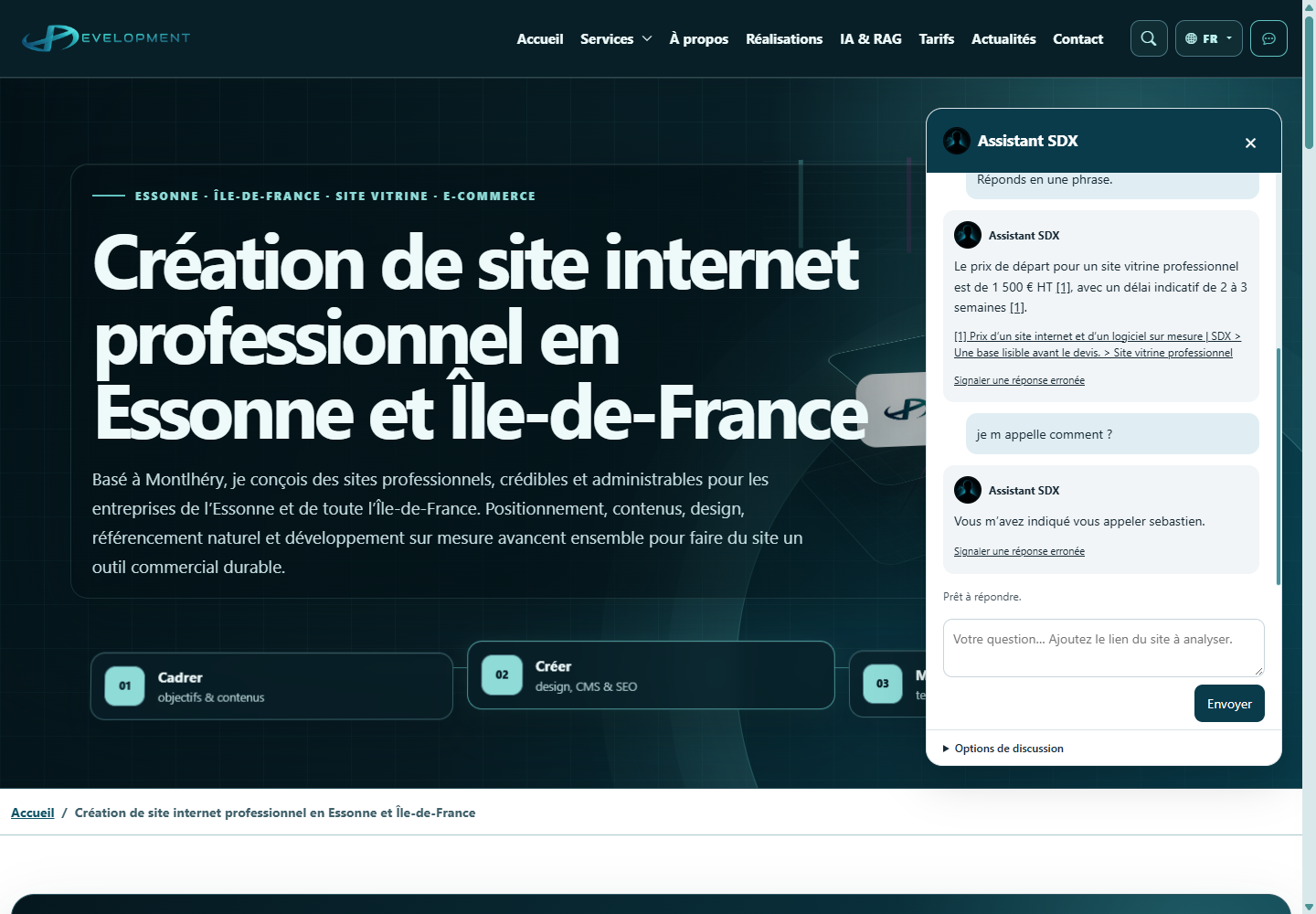
I built the SDX Development assistant to find website information and follow a conversation about a project, price, delivery time or the current page. Greetings and name recall are handled locally without document retrieval.
RAG runs when the request needs sources. The server retrieves passages; embeddings, writing and checking use the browser’s GPU through WebGPU. A name can be kept in an optional local profile. After navigation or two minutes of inactivity with the chat closed, a personalised invitation can appear beside the widget without opening the conversation window.
Progress documented on 3 October 2026. Generation has no API charge per question, but requires an initial download and a compatible browser. Retrieval stays connected to the server, which may retain unanswered questions. Measurements on S25 Ultra and desktop report total timings and tokens/s. Mobile tests still show missing VAT qualification and citations and a confused timeline; the case study documents these reviewer limitations.
RAG can retrieve useful passages from an authorised collection and ground an answer in those sources. Relevance and errors are evaluated on questions representative of your actual workflows, including the languages the service must support.
n8n and APIs can connect a request, an approval and a business update. Permissions, errors, alerts and recovery are planned; sensitive decisions retain human approval.
The project starts with representative images and a precise detection objective. Capture conditions, acceptable errors and integration with the field application guide the prototype.
A prototype measures feasibility: output quality, response time, failure cases and cost per use. Data sensitivity, access rights, model providers and hosting requirements are examined during discovery, including any European data-location requirements and external services involved.
Model pricing is only one part of the cost. Data preparation, integration, evaluation, monitoring and maintenance are assessed separately. Published prices provide a starting point; production delivery depends on the prototype results and an agreed scope.
RATP Toilettes Connectées — This project illustrates the integration of sensor and operational data into business software. It includes ingestion, synchronisation and correlation; it is not presented as a deployed AI reference.
No. The useful scope, permissions, excluded data and provider are defined for the project. Data flows are designed around those constraints, and any external transfer is considered when choosing the integration.
A representative test set makes it possible to compare quality, latency and cost. The choice depends on the task and can evolve without rebuilding the whole integration.
No. Scaling, monitoring, advanced access controls and availability commitments require a separately defined scope and validation before operational use.
Let us define the workflow, available data and decision to improve before selecting a model or technology. We can review the use case remotely with your European or international team.
Enter at least 2 characters to start searching.