
Select the knowledge
Choose content, add supplementary information and prepare the document index.

SDX · RAG AI assistant
A complete AI application: CMS knowledge, vector retrieval, local memory and answers written then reviewed on the visitor’s GPU.
All case studies Enlarge screenshot
01 / RAG
Website pages explain an offer, pricing and how a business works. Visitors do not always know where to look. The goal was to let them ask a question and find an answer connected to the information already published.
I built this application on SDX Development’s own website. This internal project is live in production and brings together document retrieval, local models, knowledge administration and a conversation interface.
02 / RAG
RAG connects text generation to information retrieved from a document index. In this implementation, the visitor’s browser and the website server share the work.
The CMS prepares an index from selected content and information added by the administrator.
The browser computes a representation of the question. The server searches the index for relevant passages and returns their sources.
A model running in the browser writes an answer using the retrieved passages. Additional retrieval can enrich the context.
A local check examines the draft before it is displayed. If the information is insufficient, the assistant suggests getting in touch.
Generation runs on the visitor’s device with GPU access. The service is not fully offline: it downloads models and queries the server for sources. Unanswered questions may be retained to improve the knowledge base.
The server stores the knowledge and retrieves passages. The browser runs query rewriting, embedding, writing and review models. Optional local conversation memory is a third resource: it helps follow the request without replacing documentary sources.
The current request, recent exchanges and, when enabled, a public web reference supplied by the visitor.
The model turns the request into a self-contained documentary query. The original question is retained alongside its rewrite.
Queries become numerical vectors calculated with WebGPU. These vectors are sent to the site API.
The index selects passages in the right language, applies the similarity threshold and combines rankings. It returns texts, titles and source links.
If allowed by the visitor, a related earlier question is retrieved from IndexedDB. It supplements recent exchanges without treating its old answer as evidence.
The response model uses CMS instructions, the question, conversation context and retrieved passages. The draft is not yet displayed.
The same model checks the draft against the sources. If rejected: at most one additional search and a second writing attempt.
An accepted draft is displayed with sources. When evidence is insufficient, a human handoff is offered. An eligible exchange may be saved locally.
Before visitor questions: the administrator prepares content and calculates its embeddings in their browser. Documentary vectors are stored on the server. The 855 fragments in the validated index are not recalculated on every visitor’s phone.
EXECUTION
WebGPU gives browsers access to GPU computation. Here it handles inference: applying model weights to produce an embedding or generate text. Local execution avoids calling a hosted generation API for each answer. It still requires compatible browser support, drivers and GPU resources, on an HTTPS page.
The presence of navigator.gpu is insufficient. The application checks the hardware adapter and rejects a fallback software adapter. Physical tests included the Samsung Galaxy S25 Ultra’s Adreno 830 in Samsung Internet and an NVIDIA Ampere GPU on a computer. Features and buffer limits vary: browser branding and total phone RAM do not prove that an export will run.
Gemma 4 E2B uses LiteRT-LM, with @litert-lm/core pinned to 0.17.1, the GPU_ARTISAN backend explicitly requested, a 4,096-token context window and thinking disabled. The LiteRT-LM Web API remains an early preview, qualified here on the tested devices. E5 embeddings use a separate path: ONNX Runtime Web with WebGPU. Several ONNX exports, WebLLM/MLC and compact runtimes were evaluated before this choice.
Experimental compact runtimes also required work on WGSL shaders, quantized weights and cached model states. The Nanbeige 4.2 path must respect its architecture’s two passes: dropping a pass to save time would not be an equivalent optimization. A lightweight format or smaller model is insufficient; its operations must run correctly on that GPU and the RAG pipeline must remain reliable.
Integration required two separate Web Workers. The LiteRT SDK uses importScripts and starts in a classic worker; the embedding worker is a JavaScript module. This keeps the response model loaded during E5 retrieval and the interface responsive. Cancellation covers both workers; GPU loss releases the runtimes and reports an actionable error.
KNOWLEDGE
The CMS selects published pages, approved knowledge entries and eligible form information. Prepared text is split using the actual embedding tokenizer: 400-token passages with a 40-token overlap, a bounded title and a check of the 512-token limit after adding the prefix. Oversized passages are rejected instead of silently truncating information.
The selected Multilingual E5 Base profile produces 768-dimensional vectors. Inputs distinguish query: for questions and passage: for documents. Outputs use masked mean pooling and L2 normalization. Indexing and retrieval must use identical operations: a correctly sized vector can still be numerically wrong.
On mobile, the MatMulInteger path in some quantized exports was incompatible with the runtime used. A reproducible preparation tool retains INT8 weights while adapting matrix operations to a portable FP32 path. E5 artefacts undergo SHA-256 verification and comparison with four numerical reference fixtures, requiring a cosine of at least 0.999. References are calculated outside the browser; visitor inference remains on WebGPU.
MariaDB stores vectors in a VECTOR(1024) column. Remaining dimensions are padded with zeroes, preserving cosine calculations. Each index is linked to its embedding profile and each passage to its content hash. Outdated batches and unnormalized vectors are rejected.
For each question, the server ranks passages by cosine distance, filters language and still-published sources, applies the configured threshold and limits passages from any one document. The illustrated configuration keeps four passages with a 0.75 threshold. E5 Small, 384 dimensions and about 118 MB versus Base’s 279 MB, is available for further testing; it needs its own index and cannot be derived by shortening Base vectors.
CONTEXT
A follow-up such as “what about maintenance?” is hard to search without its earlier topic. A first model pass creates a self-contained query from the request, recent exchanges and any reference. Output cleaning prevents model commentary from becoming a search query. If rewriting fails without a fatal runtime error, search can fall back to the original question.
The search retains the question and its rewrite when they provide distinct queries. The server combines their rankings through reciprocal rank fusion: passage ranks are combined rather than letting a rewrite entirely replace the visitor’s request. This reduces the risk of losing an important detail during rewriting.
Persistent memory is optional and stored in the visitor’s browser through IndexedDB: up to 60 exchanges for 7 days. Entries contain a question, answer, vector, language, embedding profile and timestamp. Expired entries are removed when accessed; users can disable or clear memory. If storage is unavailable, discussion continues without persistence.
Memory includes local semantic retrieval. The current question vector is compared with earlier questions in the same language and embedding profile; the best result above the profile threshold can enrich context. Recent exchanges take priority. An old generated answer is not reintroduced as a factual source: only the relevant earlier question supplies distant background context.
QUALITY
The writing prompt combines the CMS role and instructions, latest request, useful conversation history and retrieved passages. Sources are presented as data separate from system instructions. Drafts remain private: the interface displays progress, followed by an accepted answer. Waiting therefore includes multiple inference passes, not just visible writing.
A second pass of the same model assesses whether the draft addresses the question and whether essential facts are supported. LiteRT structured exchanges use a local emit_result tool with no external action. The application validates JSON objects and required field types. Valid JSON alone does not establish that the assessment is correct.
One real bug involved unequal source context: the writer saw up to 1,250 characters per passage, while the reviewer saw only 650. A price range farther down could be missing from review. Both passes now receive the same sources with a 1,250-character limit, avoiding a request to verify evidence withheld from the reviewer.
A rejected draft can trigger corrective retrieval and a second version. The process is bounded: at most two drafts and one additional search. Repeated old answers and internal commentary are filtered too. Without an acceptable answer, the assistant states the limitation and offers contact.
Native generation counters are retained; empty outputs and outputs reaching their token cap are rejected. No completion signal absent from the SDK is fabricated. Review reduces some defects but uses the same model as writing and can be wrong itself. False drafts and missing-information cases are essential tests; visitors can still inspect sources.
03 / CMS
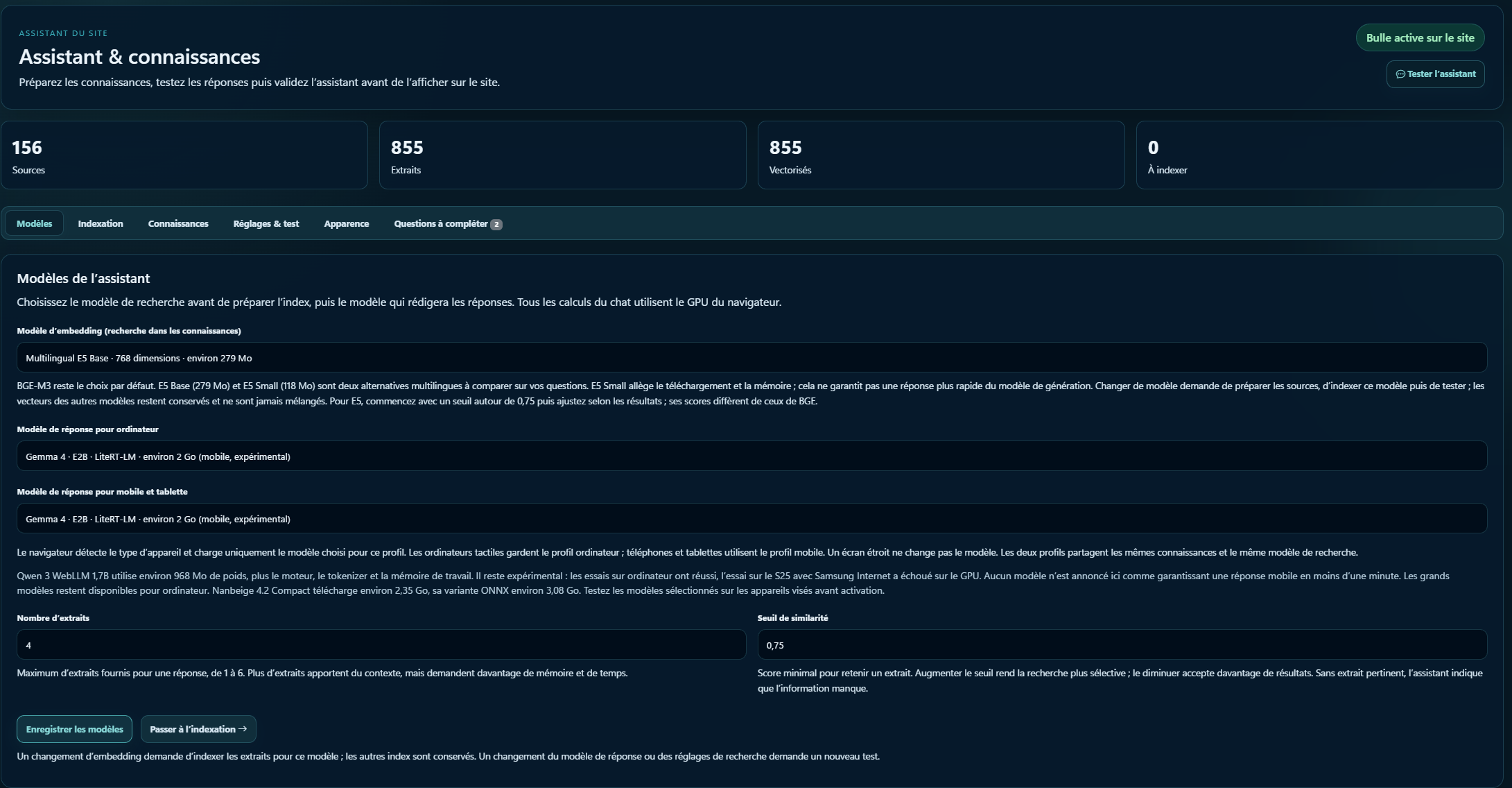
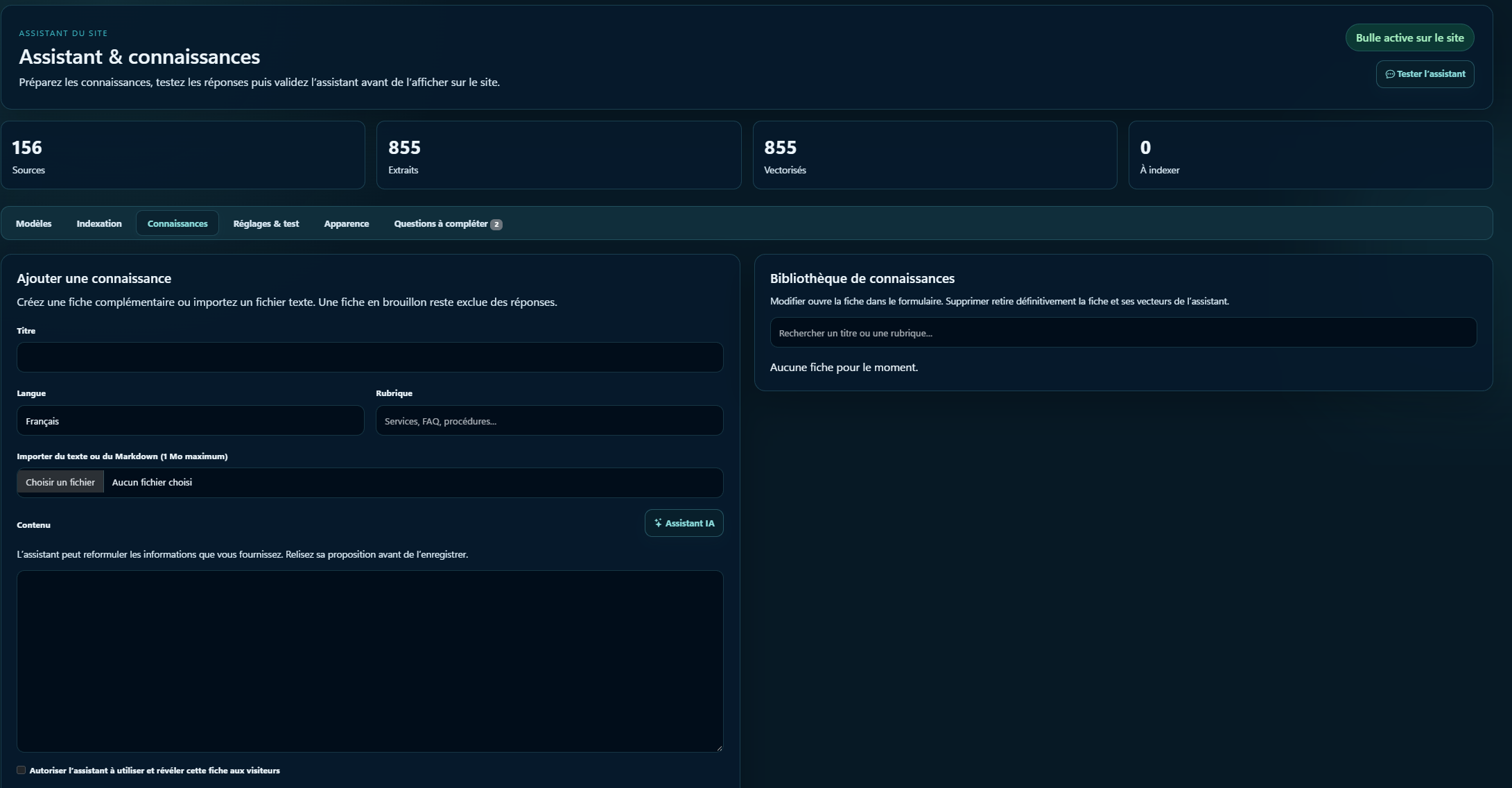
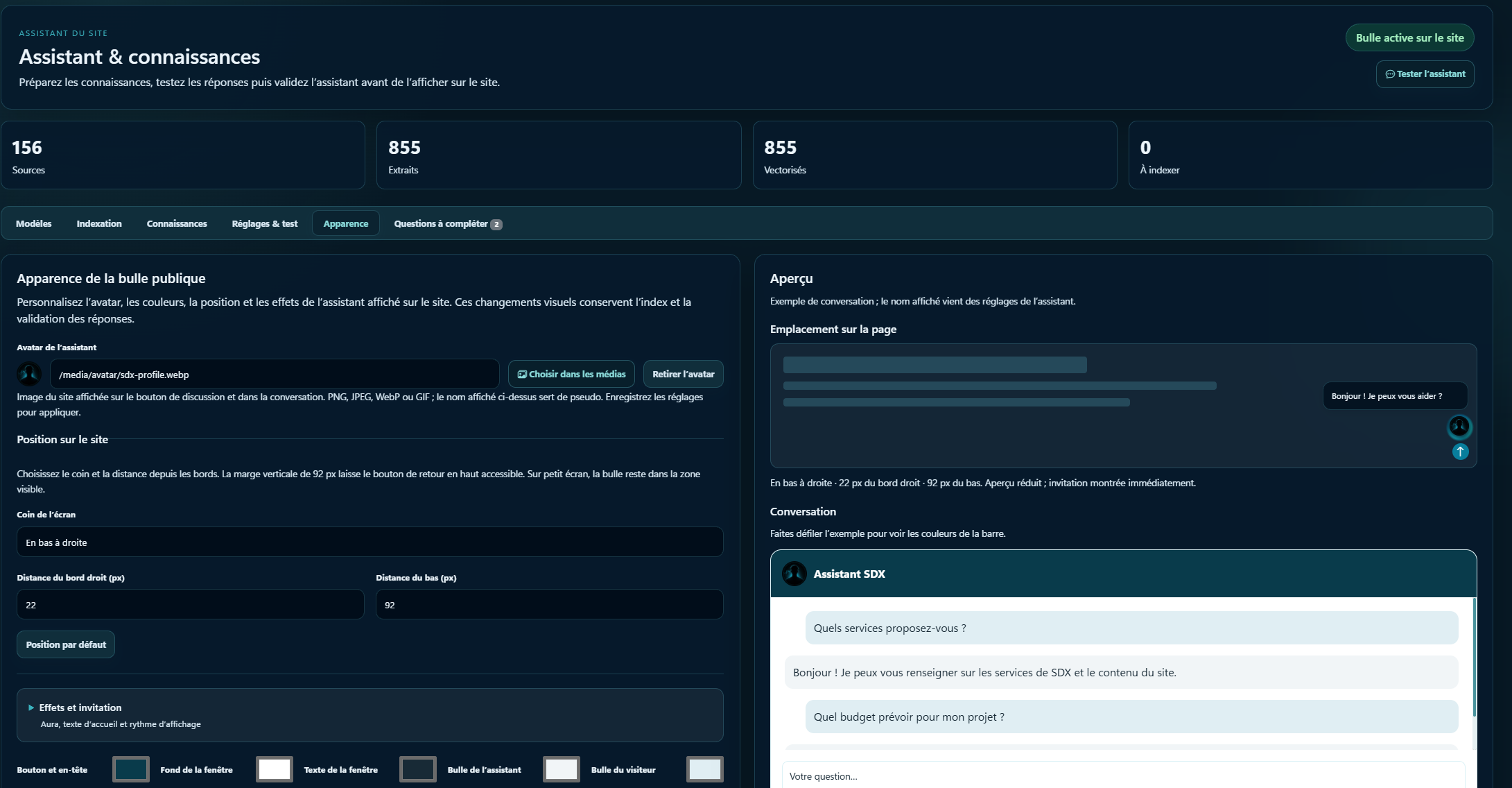
The CMS brings together the settings that keep the assistant useful: knowledge, behaviour, models and appearance.
Choose content, add supplementary information and prepare the document index.
Separate mobile and desktop response models, selected on the client. The embedding model is configurable.
Answer tests and validation in the administration interface before making the assistant available.
Name, greeting, instructions and available features, with a route towards contacting the business.
Colours, avatar, position and preview. Adjustable aura: motion, direction, speed and maximum expansion.
Uncovered questions help identify information to add before testing the workflow again.
Production CMS captured in Chrome on 27 September 2026. The framing shows assistant features and excludes the account bar. The knowledge form is empty; the appearance preview contains a demonstration conversation.
 Enlarge screenshot
 Enlarge screenshot
 Enlarge screenshot
04 / MOBILE
Shadow DOM isolates the widget from site styles. On Android, readability also requires tracking the keyboard and the actual visible viewport.
The panel uses the available height and hides launcher-shell during discussion. Secondary controls are collapsed to leave room for messages.
VisualViewport supplies visible height and offset when the Android keyboard opens. The panel follows them; input grows from 44 to at most 96 px and send remains accessible.
Screen Wake Lock is requested during discussion, reacquired when returning to the foreground and released on closing. The browser or system can refuse it; no permanent phone setting is changed.
 Enlarge screenshot
for the pricing question tested on the S25 Ultra
05 / Measured on a real device
On 27 September 2026, in Samsung Internet, the public assistant answered a question about professional brochure website pricing in approximately 36 seconds, including its answer check and sources. It retrieved the published range of €1,500–€5,000 excluding VAT.
A single measurement with model files already downloaded, rather than a guarantee for every request. The initial download is large; complex questions or corrective retrieval can take more than a minute. Hardware and browser GPU access affect the outcome.
Production configuration after the 27 September 2026 tests: Gemma E2B is selected for both independent profiles. The choice follows pipeline quality and real measurements.
Measurements from 27 September 2026. Timings cover a RAG request through its reviewed answer, with weights already downloaded. They include retrieval and multiple model passes, rather than decoding alone.
| Device / candidate | Observed duration | Pipeline result |
|---|---|---|
| S25 Ultra · Samsung Internet · Gemma 4 E2B | 36.11 s | Price question: complete, reviewed answer, €1,500–€5,000 excluding VAT. |
| Desktop · Chrome / NVIDIA Ampere · Gemma 4 E2B | 12.25 s | Same question: 114 tokens; review also rejects a false-price draft. |
| Same desktop · Nanbeige 4.2 Compact | 120.73 s | Correct nominal answer, 238 tokens; false draft incorrectly accepted in a counter-test. |
| Same desktop · Gemma E2B · final validation | 13.06 s | Real test recorded in the CMS, followed by activation of the model shared by both profiles. |
Answers differ in length, and rewriting can change retrieved passages: these timings are not a universal model ranking. The counter-test supplied a €15,000–€100,000 draft against €1,500–€5,000 sources. A correct simple answer from Nanbeige was insufficient to qualify its reviewer.
On this desktop, Gemma E2B handled a price objection in 15.02 s and maintenance in 12.99 s. A false “24 hours for €100” promise and an unpublished exact turnover led to human handoff in 25.91 s and 23.59 s. Refusing to invent information was part of the test.
Mobile trials showed that smaller downloads do not guarantee a reliable pipeline: candidates lost the GPU, repeated text or failed review. The tested Qwen 3.5 4B and Gemma 3 4B ONNX exports produced no final desktop answer on this path. This describes those exports and runtimes, not every use of the models.
Embedding was measured separately on the S25 with cached weights: Base took 4.275 s for loading, checks and the first question, then 90–103 ms; Small took 3.487 s, then 24–27 ms. The small ranking test used five passages, not the site’s 855 fragments. Most of the long wait came from response-model passes: replacing embeddings alone would not fix it.
DATA
Response inference and persistent memory run on the device. The service remains connected: it downloads models and libraries, sends search vectors to the server and receives source texts. An embedding is not an anonymity guarantee. Uncovered questions can be recorded in the CMS to improve knowledge, for at most 90 days without a new request and up to 5,000 questions per site.
APIs enforce site scope, administrator sessions and operation-appropriate CSRF protections. Incoming vectors are checked for profile, dimensions, finite values and normalization. Search excludes withdrawn pages and unauthorized forms; draft knowledge entries are not exposed in answers.
When web references are enabled, the server can read a public URL supplied by the visitor. Protocols, network addresses and redirects are checked to block private-network access. Downloads have size and time limits. Useful text is extracted without running page scripts and remains external reference data, not a new system instruction.
The assistant can also help prefill an authorized form from information explicitly supplied by the visitor. Field schemas, language, target form and validity duration are checked. Existing values are preserved, consent is never automatically checked, and no form is submitted without user action.
RELEASE
The CMS does more than select a model name. It prepares sources, resumes indexing, tracks pending passages and offers real tests. Mobile/tablet and desktop response profiles are independent. Client detection uses browser and device information; narrowing a desktop window does not switch it to a mobile model.
A test is linked to the model, configuration and retrieval performed. Changing a model, instructions or index invalidates the relevant qualification: another test and reactivation are required. Configuration signatures prevent activation based only on an obsolete test. Purely visual settings preserve answer qualification.
Verification covered real GPU generation, numerical embedding consistency, price and maintenance questions, false promises and unpublished figures. Mobile fixes were also checked with the keyboard open, panel opening and closing, an accessible send button and no overflow. Releases back up the affected scope and verify public pages.
Remaining work has specific targets: broaden qualification questions, measure cold downloads and quotas, check more browser/GPU pairs and compare new Adreno-compatible exports. A native app could access other accelerators; hosted inference could reduce phone workload. These alternatives would change the architecture and are not presented as already delivered.
Project tests support the choices and timings in this case study. These documents explain the technologies; they do not guarantee performance on a particular device.
Visitors can ask about the content and check its sources. The administrator can enrich the knowledge, configure the assistant and test its answers. The project covers the complete workflow, from editing content to using it in a conversation.
Explore AI & RAG services
Business software and products
A business ERP connecting job management, constraint-based scheduling, inventory, invoicing and a customer portal, with ITS Report for video inspection.
Explore the project : Idea to Software
Professional websites
An industrial website with a custom CMS: technical content, the C.A.R.E. method, project references, franchise information and diagnostic enquiries.
Explore the project : RésilinerWhat are you working on?
Documentation, catalogues, procedures or services: let’s define sources, users and expected answers to build an assistant around your business.
Enter at least 2 characters to start searching.