
Processing…
AI & cybersecurity
OpenAI introduces GPT-6 Astra, a model designed to carry out complex tasks from start to finish: browsing the web, using software, coding, producing documents, and working in cybersecurity.
OpenAI has just introduced GPT-6 Astra, its new flagship model. As with every new generation, the figures improve in reasoning, programming, and various benchmarks. But the most interesting new development is probably elsewhere.
With Astra, OpenAI is above all emphasizing the model’s ability to act directly within a computing environment. Browsing a website, filling out a form, modifying data in a CRM, using software, analyzing files, creating an interface, testing a site, or working on a codebase become different stages of the same process.
The boundary between an assistant that explains how to perform a task and an agent that actually participates in its execution is therefore becoming thinner. For developers, SaaS publishers, and companies automating part of their processes, this development is probably more significant than simply moving from one model number to another. OpenAI presents Astra as its most capable model to date for reasoning, coding, computer use, research, and document creation.
GPT-6 Astra is the new generation of flagship model introduced by OpenAI on September 3, 2026. The company positions it as its most advanced model for tasks requiring reasoning, coding, research, tool use, and complex sequences of actions.
However, it would be reductive to view it simply as a chatbot that answers questions better.
Previous models could already generate code, analyze a document, or search for information. Astra aims instead to bring these different capabilities together within the same process. A request might begin with research, continue with the use of an application, require modifying several files, and end with testing and producing a usable result.
It is this continuity that deserves particular attention.
The goal is no longer merely to generate the next answer. It is gradually becoming about carrying out a mission through to its result.
OpenAI devotes a significant part of Astra’s presentation to what it calls “computer use.”
The principle is to allow the model to interact with the tools we use every day rather than limiting it to a chat window.
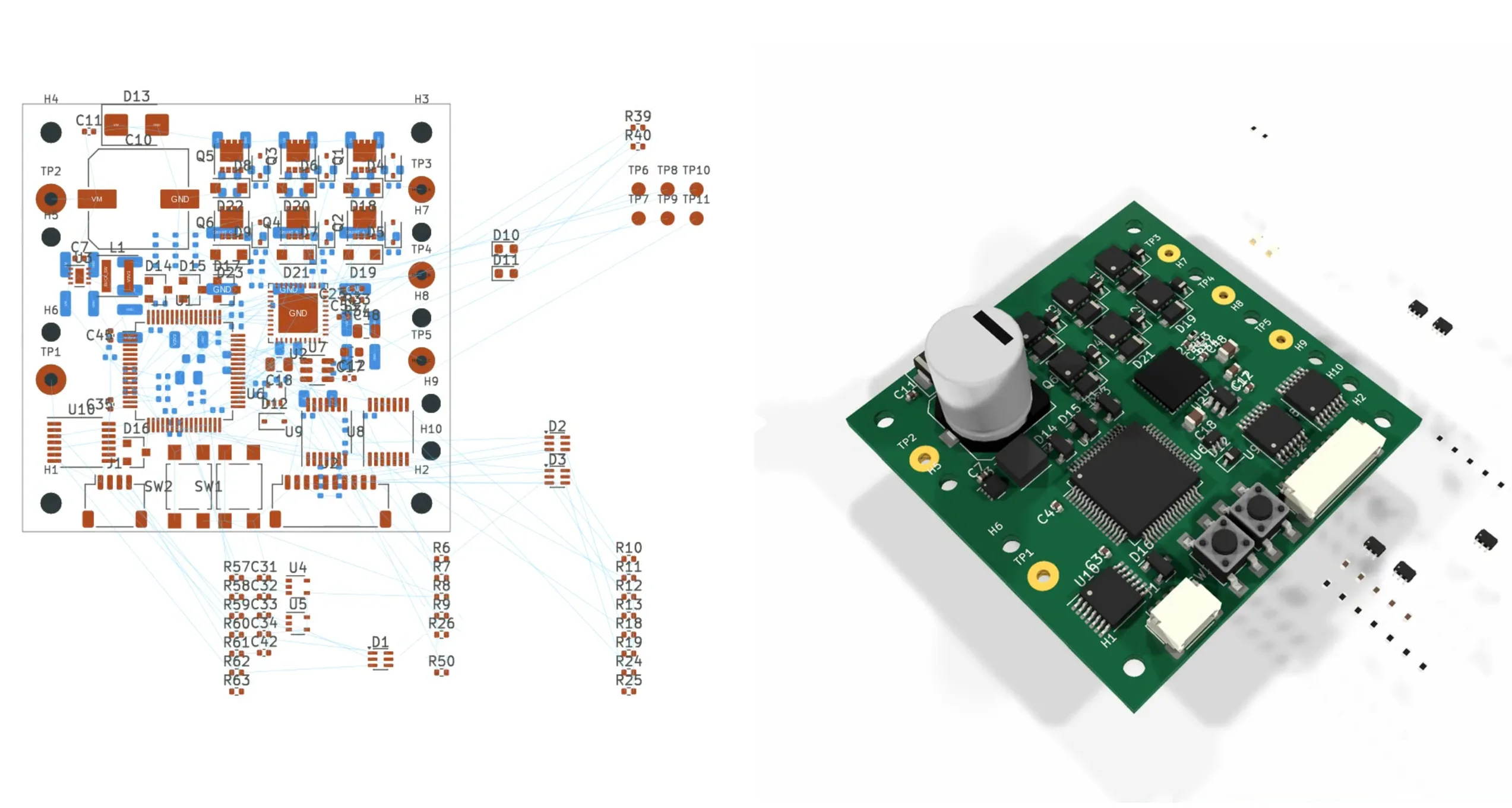
OpenAI notably presents scenarios in which Astra can fill out forms, update information in a CRM, organize a calendar, conduct an online search, use a document editor, analyze data, or perform checks on a web interface. It can also install and test certain software or diagnose problems appearing directly on the screen.
For a human, each of these actions seems relatively ordinary.
For an AI, chaining them together is much more difficult.
It must understand what is displayed, identify the appropriate action, use the interface correctly, observe the result, detect any possible error, and then adjust its strategy if necessary.
Progress therefore comes as much from the ability to act and verify as from the ability to reason.
For several years, using an LLM mainly followed a simple pattern:
question → answer → human action.
The user asked how to perform a task. The model produced an explanation. A person then carried out the necessary steps.
Agents are gradually introducing a different structure:
objective → planning → actions → checks → result.
Consider the example of testing a website.
An assistant can explain how to test a form.
An agent could potentially open the site, complete the form, submit it, check the resulting behavior, investigate any error, and then send a report.
OpenAI is specifically showing Astra performing frontend QA tasks and working directly in different software environments. In its own computer-task evaluations, the company also reports a significant reduction in the time required for certain operations compared with GPT-5.6 Sol.
This difference may seem subtle. Yet it fundamentally changes how AI is integrated into an application.
AI is no longer merely becoming a conversational interface. It can become a component of an operational process.
Software development is naturally one of the areas most affected.
Current models can already generate a function or suggest a fix. Development agents go further: they can explore a codebase, understand multiple files, modify the project, run commands, use a browser, and visually verify the result.
OpenAI presents Astra as its best-performing model to date for software engineering. Companies such as Jane Street and Lovable, which participated in the evaluations, notably describe improved understanding of codebases and a reduction in the number of iterations needed to obtain a usable result.
For a web developer, the difference could take a very concrete form.
Instead of asking:
“Write this React component for me.”
we can gradually move toward an instruction such as:
“Add this feature, follow the existing architecture, update the API, check permissions, add the tests, and then verify the result in the browser.”
The model must then understand several layers of the project and maintain the same objective throughout the entire intervention.
The challenge is no longer merely to produce valid code. It is to modify an existing system without breaking its rules.

This capability immediately raises a problem familiar to developers using agents: context.
A major modification may require several hours of work and dozens of actions. Over time, a model must remember why a decision was made, which tests failed, which approaches have already been tried, and which constraints must continue to be respected.
In the API, Astra has an announced context window of 1,050,000 tokens, with up to 128,000 output tokens.
Context window and API limits ↗
Size alone does not solve everything, however.
With Astra, OpenAI is also introducing a new experimental approach in Codex that allows the model to retain notes across context windows and search through earlier parts of a long session. The goal is to prevent important details from disappearing when the work becomes too large to remain entirely within the active context.
This is an interesting change for long tasks such as a redesign, migration, or analysis of a large codebase.
An effective agent must not only understand a great deal of information.
It must know how to retrieve the right information several hours later.
Astra is not aimed only at developers.
OpenAI says it specifically trained the model to work on documents, spreadsheets, presentations, and other professional deliverables while more closely respecting the templates and constraints supplied by the user.
This development matters because much of a company’s work does not require creating entirely original content.
It instead requires working within an existing environment.
A report has a structure. A presentation follows a visual identity. An Excel file uses certain columns. A sales document uses precise terminology. A business procedure has rules that must not be improvised.
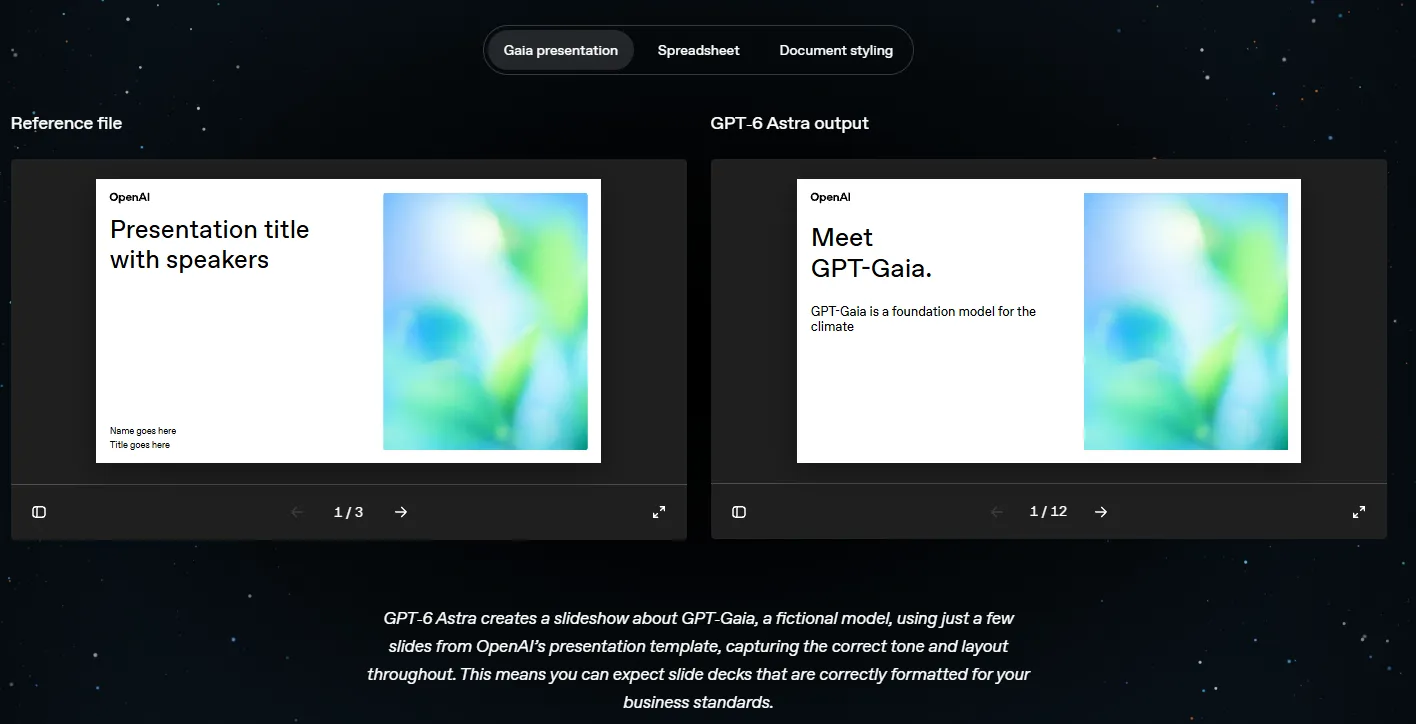
The quality of a professional agent therefore depends less on its ability to produce something impressive than on its ability not to break existing conventions.
This distinction directly relates to the challenges encountered when integrating AI into business software.
The real problem is almost never making a demonstration work.
It is making AI work within the company’s rules.
OpenAI accompanies Astra with numerous benchmark results.
For Agents’ Last Exam, an evaluation covering professional tasks performed in real software, and OSWorld 2.0, OpenAI reports the following results:
| Evaluation | GPT-6 Astra | GPT-5.6 Sol |
|---|---|---|
| Agents’ Last Exam | 59.3% | 53.6% |
| OSWorld 2.0 | 72.6% | 65.7% |
For OSWorld 2.0, this is the August 8, 2026 version, using the offline subset with partial scoring. View the results and methodology ↗.
The company also publishes very high results in abstract reasoning, mathematics, and cybersecurity.
These figures help measure progress, but they should not be interpreted as a guarantee of results in a real application.
OpenAI itself points out that its models may be evaluated in research environments or with configurations different from those used in production. The benchmarks published by the provider also remain evaluations that should be distinguished from an independent audit of a specific use case.
The important question for a company is not whether a model scores 72% or 60% on a general evaluation. It is how it behaves with your data, permissions, business rules, and edge cases.
An extremely capable model can still make a poor decision if the scope of its action is poorly defined.
This is probably the most unusual element of this release.
GPT-6 Astra is the first model that OpenAI considers to have reached its Critical level for cybersecurity capabilities under its Preparedness Framework.
OpenAI explains that, with the appropriate tools and access, a model at this level may be capable of discovering unknown vulnerabilities and developing methods to exploit them on heavily protected systems with far less human intervention.
In evaluations without production safeguards, OpenAI reports, among other results, a score of 100% on ExploitBench compared with 78.5% for GPT-5.6 Sol. The company also says that Astra discovered two previously unknown zero-day vulnerabilities during a recent evaluation and that notification to the maintainers of the affected software is underway.
This capability obviously has two sides.
For a defender, a model capable of quickly understanding a vulnerability can accelerate a security review, the identification of a weakness, or the preparation of a fix.
For an attacker, the same capabilities may lower the level of expertise required for certain operations.
This is why OpenAI currently limits certain advanced cyber uses and applies additional protections around the model.
Read Astra’s protection overview ↗
The more capable an AI is of acting, the less its security can rely solely on the quality of its answers.
A bad answer in a conversation can be corrected.
A bad action performed on a system can have much greater consequences.
OpenAI therefore says it has strengthened several layers of protection around Astra: action monitoring, detection of out-of-scope behavior, additional controls for sensitive tasks, and the ability to interrupt certain operations. In ChatGPT or Codex, some actions may require review before continuing; in the API, a task may be stopped by these mechanisms.
The principle goes far beyond Astra.
As agents gain access to files, databases, internal tools, or external services, a robust architecture must define at least:
In other words, the more capable the agent becomes, the more important the system around it becomes.
For a small or medium-sized business, the question is probably not “how do we replace the entire team with GPT-6 Astra?”
The most realistic opportunities are much more specific.
Consider business software in which someone handles customer requests every day.
Today, AI can summarize the request and suggest a response.
Tomorrow, an agent could potentially examine the request, consult the customer record, verify information in another service, prepare a change, fill in certain fields, and then request approval before the important action.
The difference is considerable.
AI moves from a role of producing information to a role of coordinating work.
For a SaaS, comparable agents could also work on support, document qualification, certain administrative checks, preparing sales actions, data analysis, or maintaining the software itself.
But these automations require an appropriate architecture.
Giving a model full access to a database or administration interface is not an integration strategy.
Actions must remain explicit, limited, and controllable.
Autonomy therefore does not eliminate human validation.
It mainly shifts validation to the moments where it provides the most value.
GPT-6 Astra’s rollout is gradual. OpenAI is starting with a limited number of organizations and announces access in the following days through ChatGPT Plus, Pro, Business, and Enterprise, as well as through the API, Microsoft Azure, and AWS Bedrock. Exact availability may therefore vary by account during the rollout.
For developers, the model identifier is:
gpt-6-astra
The API documentation indicates a context window of 1,050,000 tokens and a maximum of 128,000 generated tokens.
The announced Standard pricing is:
| Token type | Price |
|---|---|
| Input | $10 |
| Cached input | $1 |
| Output | $50 |
Specific pricing rules apply in particular to very large contexts and certain processing modes. Cache reads are separate from cache writes, which are charged at $12.50 per million tokens. Above 272,000 input tokens, input and cache prices are doubled and the output price is multiplied by 1.5 for the entire request. View the model’s pricing and limits ↗.
This cost highlights another important point for a product using AI: the best model is not necessarily the one that should handle every request.
A SaaS can combine several models depending on the task. A complex operation may justify Astra, while simple classification or short generation can be assigned to a less expensive model.
Architecture therefore becomes just as important as model selection.
GPT-6 Astra obviously represents further progress in reasoning, programming, and understanding.
But the most interesting change is probably elsewhere.
AI models are gradually leaving behind the role of simple text generators to become systems capable of understanding an objective, using tools, executing multiple steps, and checking part of their own work.
For a developer, this means AI can participate in an increasing share of the software lifecycle: exploring a project, modifying code, testing, using a browser, visually checking results, or performing security analysis.
For a company, this opens the door to a new generation of automations. Software can integrate agents capable not only of suggesting an action, but also of preparing or executing certain steps in the process.
This development does not make architecture, security, or human oversight less important.
It produces precisely the opposite effect.
When AI can only talk, an error produces a bad answer. When it can act, you must also control what it is allowed to do.
This is probably where the real breakthrough introduced by Astra lies: the model’s intelligence continues to progress, but the next step is mainly learning to entrust it with work without blindly entrusting it with the system.
This article was prepared from OpenAI’s official presentation of GPT-6 Astra, the model’s technical documentation, and the security information accompanying its launch. The performance figures mentioned correspond to evaluations reported by OpenAI and should be interpreted within the context and configurations specified by the publisher.
Sources consulted on September 5, 2026. Availability terms and pricing may change.
YOUR AI PROJECT
Models, tools, data, permissions, and human validation: genuinely useful automation must be designed as a product feature, not as a chatbot added as an afterthought.
Enter at least 2 characters to start searching.
