
With Opus 5: 10 × $5 + 2 × $25 = $100.

Processing…
AI & development
Claude Opus 5.5 targets software development and long-running tasks, with API pricing lower than Opus 5. However, adopting it requires checking settings, tools, and the compatibility of existing integrations.
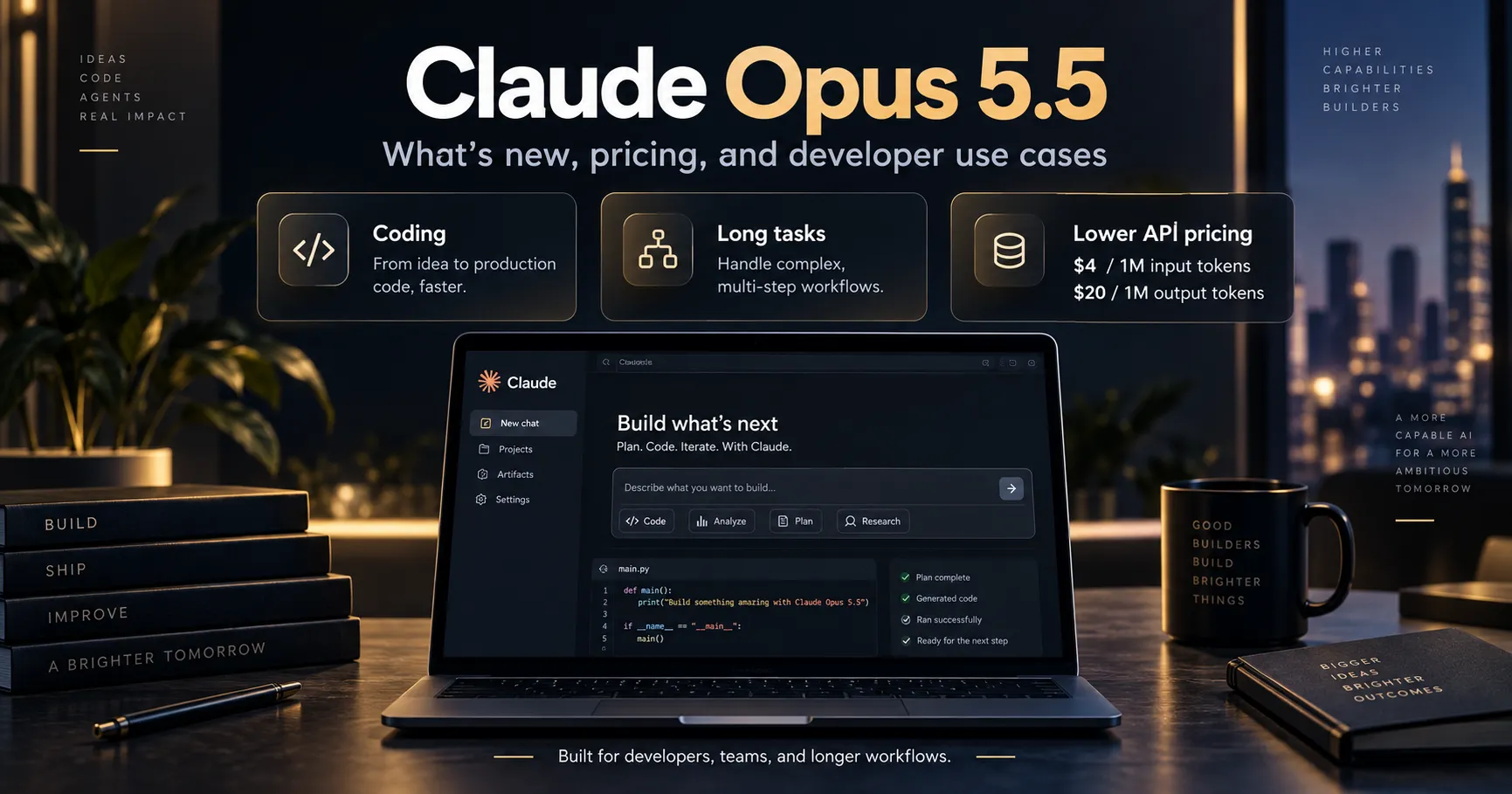
Anthropic launched Claude Opus 5.5 on September 22, 2026. The first model in the Claude 5.5 family, it focuses on software development, complex work, and cost efficiency.
For a developer, agency, or team building a SaaS, the value is not limited to having another model available. The question is more concrete: can it help complete a task correctly, with fewer interventions and at a reasonable cost?
This release should therefore be examined from several angles: use cases, pricing, speed, settings, and the changes required in an existing integration.
Anthropic presents Opus 5.5 as a model particularly suited to multi-step work: developing a feature, investigating the source of a bug, refactoring code, or conducting a review. The publisher also highlights better continuity on long-running tasks and clearer explanations of the changes made.
The value to assess therefore lies not only in the quality of an isolated generated function. In an existing application, a change must follow the project’s conventions, integrate with other components, and avoid causing regressions.
A comparative trial can start from the same requirement and the same code version, with identical validation criteria. This method makes it possible to examine the output produced rather than relying on a general impression.
The documentation indicates a context window of 1 million tokens and a maximum output of 128,000 tokens. These capabilities were already available with Opus 5, so they do not represent an increase introduced by this version.
Opus 5.5 accepts text and images as input, then produces text as output. It can therefore be used in scenarios combining code, documentation, and screenshots. To prepare a test, it is better to select the files and visual elements needed for the task rather than systematically trying to fill the entire available context.
In the results published by Anthropic, Opus 5.5 achieves 66.4% on Terminal-Bench 4.0, compared with 52.3% for Opus 5. These measurements are based on the configurations specified by the publisher and do not directly represent a productivity gain for a team.
To inform an adoption decision, these results should be complemented by an evaluation on internal tasks: fixing known bugs, reviewing changes, or implementing features whose success criteria are defined in advance.
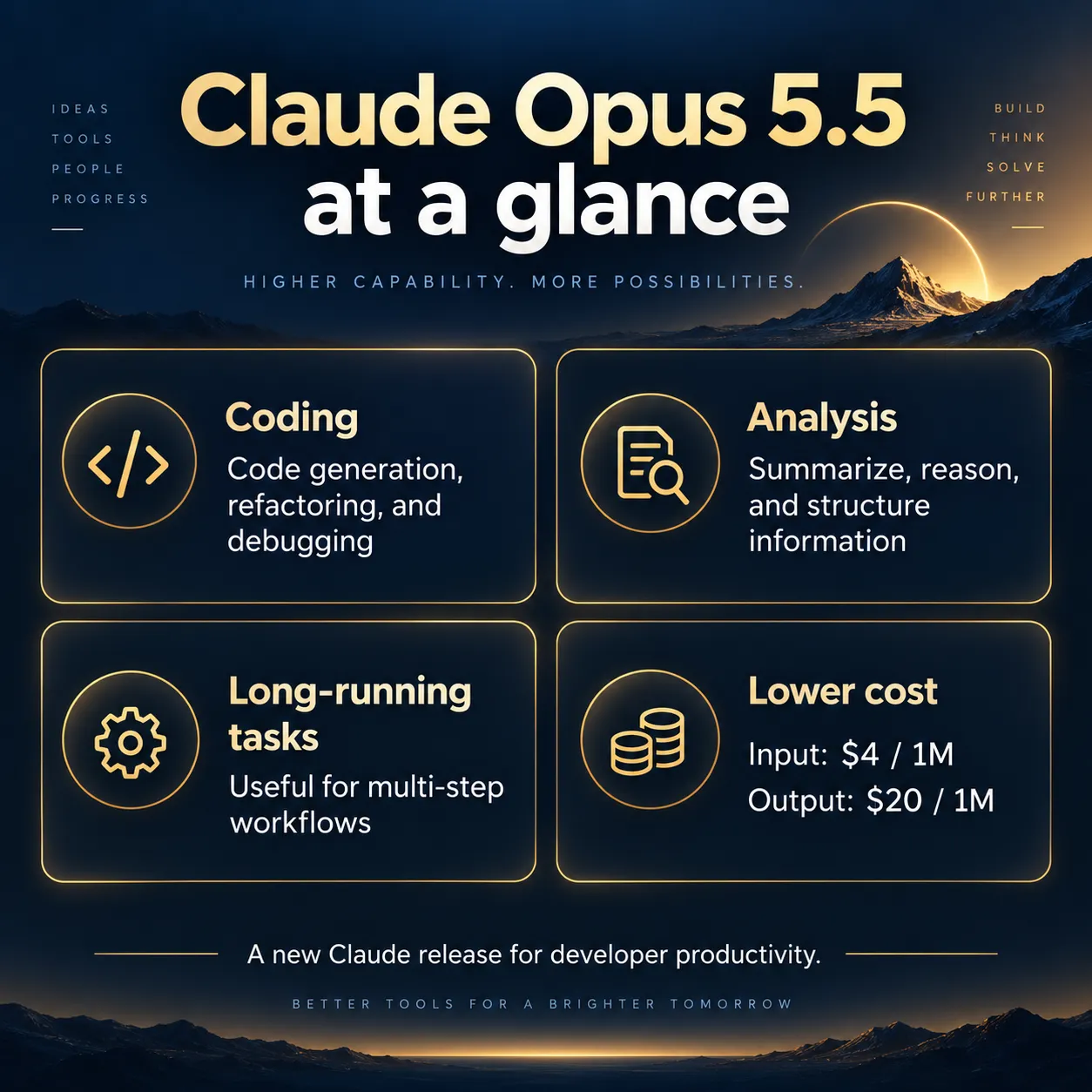
The main standard-mode API prices are expressed in US dollars per million tokens. Cache costs distinguish between initial writing and subsequent reuse.
| Consumption type | Claude Opus 5 | Claude Opus 5.5 | Change |
|---|---|---|---|
| Input tokens, excluding cache | $5 | $4 | −20% |
| Output tokens | $25 | $20 | −20% |
| Cache read | $0.50 | $0.20 | −60% |
| Cache write, 5-minute duration | $6.25 | $5 | −20% |
Reference prices verified in Anthropic documentation on September 22, 2026. These amounts concern API usage and not the monthly price of a Claude application subscription.
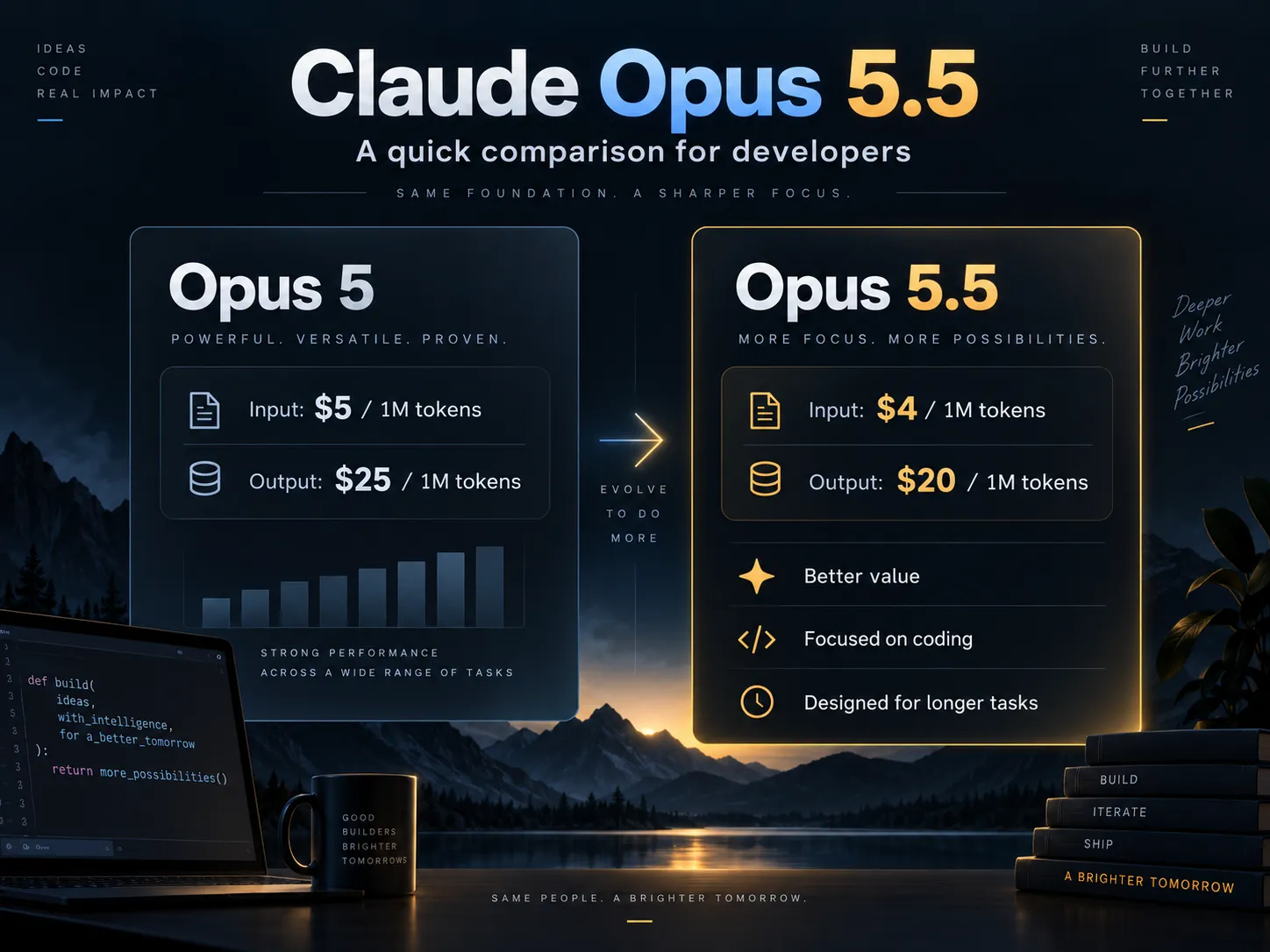
Imagine an application that consumes exactly 10 million input tokens and 2 million output tokens, with no cache, no Fast mode, and no additional tool fees.
With Opus 5: 10 × $5 + 2 × $25 = $100.
With Opus 5.5: 10 × $4 + 2 × $20 = $80.
At strictly identical volume, the savings therefore reach 20%. To obtain a different reduction, total consumption or its distribution across billed categories must also change.
Prompt caching makes it possible to reuse identical portions of the context across multiple requests. The documentation specifically recommends caching stable instructions, tool definitions, or information that is regularly reused. The relevant segments must match exactly to enable cache access.
In a development integration, one approach is to separate the project’s permanent instructions from the information that changes with each request. Before reorganizing requests, it is still preferable to measure the share that can actually be reused: a theoretical saving is useful only if the cache works under the application’s usage conditions.
Anthropic states that the model generates output tokens more than 30% faster than Opus 5. This measurement describes generation speed, but not necessarily the total duration of a task involving reasoning, tool calls, and tests.
A Fast mode is available in addition to standard operation. The documentation announces up to 2.5 times more output tokens per second, with pricing of $8 per million input tokens and $40 per million output tokens.
On the API, this option is offered as a research preview, with access subject to the terms specified by Anthropic. It is not available on partner cloud platforms. Its gain mainly concerns output throughput, not the time to the first token.
The choice should therefore address a measured need. Paying more to speed up an important interaction may be justified, but enabling this option everywhere is not automatically the best compromise.
Anthropic announces its availability in Claude for Pro, Max, Team, and Enterprise plans, as well as on its platform for developers and in the cloud environments of AWS, Google Cloud, and Microsoft Foundry.
In the Claude API, the model identifier is claude-opus-5-5. However, identifiers and integration terms depend on the platform used; the documentation notably provides a dedicated identifier for Amazon Bedrock.
For an existing application, replacement therefore requires examining more than just the model name.
Opus 5.5 introduces several changes that are incompatible with certain Opus 5 configurations. The documentation identifies four main points for API integrations.
| Point to check | Impact on the integration |
|---|---|
| Reasoning always enabled | Configurations that disable reasoning or impose the former manual budget are rejected. |
| Forced tool call | The any and tool values of tool_choice are no longer accepted. |
| Reasoning blocks linked to context | Model changes and history modifications must comply with compatibility rules. |
| Legacy computer control tool | On the Claude API and Google Cloud, computer_20251124 must be replaced by the supported mechanism. |
The exact conditions and modification examples are provided in the official migration guide.
Another change may be visible in the interface without causing an API error: some intermediate messages between tool calls arrive in thinking blocks, whose text is hidden with the default display setting. An application that used these messages to show progress should check how it processes responses.
Before production deployment, a targeted test should cover tool calls, existing conversations, streaming, and result display.
Opus 5.5 uses medium by default, whereas Opus 5 used high. The output_config.effort parameter adjusts the trade-off between processing depth, speed, and consumption. It is not a strict token ceiling.
Simply copying all the settings from an older integration is therefore not necessarily relevant. One approach is to start with medium, then compare this level with low or high on a representative task set.
The goal is not to systematically select the highest setting, but the one that delivers the required quality at an acceptable cost. The criterion can be stated simply: how much does a correctly completed and validated task cost?
The following scenarios are evaluation proposals. They are not test results produced for this article.
Choose a sufficiently representative module, such as form handling, filtering logic, or API response processing. First ask for a simplification proposal, then for a limited modification.
Validation should cover existing behaviors, tests, and the readability of the result. The goal is to determine whether the assistant genuinely improves the code rather than producing a longer rewrite.
Select a dependency or component to upgrade, with a clearly defined target version. The first step may consist of inventorying the affected uses and the incompatibilities to check. The second handles a limited part of the project and documents the remaining checks.
This scenario makes it possible to examine the quality of the diagnosis as well as that of the proposed code.
Provide a screenshot, the affected components, and observable goals: fix overflow, preserve visual hierarchy, or make a form usable on a small screen.
Examine the provided form on this development copy.
Objective: fix mobile overflow without changing validation rules or adding a dependency.
Start by identifying the probable causes. Then propose a change limited to the affected components.
After the modification, indicate the files affected, the checks performed, and the points that still need testing.
Do not deploy anything and do not use any production access.
To compare two models, keeping the same starting point and the same validation criteria makes the results more useful.
A successful first trial is not enough to determine the best choice for every use case. An internal evaluation can rely on a small set of known tasks: a few bugs, a refactoring, a structured extraction, and an interface modification.
For each one, it is useful to record:
It is also important to distinguish completed work from work presented as completed. A convincing conclusion from the model does not replace the checks planned in the protocol.
This method enables a more precise decision than a blanket replacement: adopt the model for tasks where it provides a benefit, keep the current integration elsewhere, and reassess the choice after gathering feedback.
Anthropic announces that Claude Sonnet 5.5 and Claude Haiku 5.5 will follow in the coming weeks. The announcement provides neither a specific date nor a complete pricing grid for these two models.
For teams preparing their architecture, the right approach is therefore to keep model selection configurable and tests reusable. Upcoming releases can then be evaluated against the same needs without rebuilding the entire comparison method.
Claude Opus 5.5 offers a new opportunity to reassess the use of AI in a development project. However, adoption should not rely solely on a version number, a benchmark, or an impressive demonstration.
The choice comes down to integration: compatibility, settings, quality of changes, and validation effort. For an independent developer as well as for a team, the most useful approach remains gradual: choose a concrete use case, measure the result, then expand usage when the benefit has been demonstrated.
The real gain is not producing more code, but achieving a usable result with a controlled total cost.
Article based on Anthropic’s announcement and its documentation on the model, pricing, migration, and settings.
The performance gains mentioned are attributed to the publisher; no benchmark conducted by SDX is presented. The billing example is an illustrative calculation at identical consumption.
AI & DEVELOPMENT
Model choice, real costs, response quality, security and product integration: build a measurable use case, not an isolated demo.
Enter at least 2 characters to start searching.